

A recently published peer-reviewed study from Gentherm’s Integrative Human Research Lab is exploring a question many people may not have considered:
Can everyday seat technologies help reduce perceived low-back discomfort while fitting naturally into daily routines?
Published in Bioengineering, the study examined how heated massage technologies integrated within a seated environment affected perceptions of low-back discomfort and tightness among adults living with chronic, non-specific low-back pain.
For many people, sitting is simply part of the day. Whether working, traveling, gaming, commuting, or relaxing at home, prolonged sitting can contribute to feelings of discomfort. In fact, low-back pain is one of the most common musculoskeletal conditions worldwide.
The Study
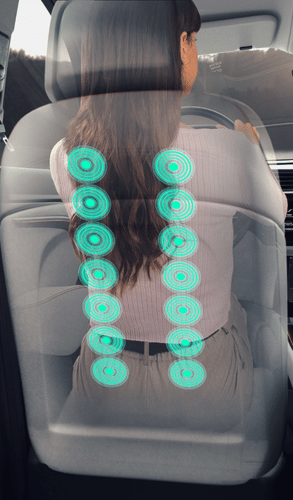
In the study, researchers recruited adults living with chronic, non-specific low-back pain and evaluated two different heated massage experiences delivered through a seat. Both massage experiences applied alternating contralateral pressure to the lower back and upper thighs, with one being continuous smooth pressure and the second incorporating Puls.A™, a rhythmic pulsation. Both approaches combined localized heating with seat-integrated massage technologies and were delivered over a 20-minute session designed to reflect a realistic every day timeframe.
What Researchers Observed
The researchers observed positive changes across both heated massage conditions during the 20-minute sessions.
Participants reported reductions in perceived low-back discomfort and back tightness, while also experiencing greater thermal comfort as the seat technologies were activated.
One particularly interesting finding involved the condition that incorporated rhythmic pneumatic pulsation massage, where participants reported earlier and greater reductions in perceived tightness, and researchers also observed improvements in tissue elasticity measurements.
Key observations included:
- Reduced perceived low-back discomfort
- Reduced perceived back tightness
- Increased thermal comfort
- Earlier and greater reduction in tightness with rhythmic pulsation massage
While the study focused on short-term effects in a controlled environment, the findings help advance understanding of how integrated seat technologies can contribute to comfort and wellness experiences during everyday use.

The Future of Comfort
The publication reflects a broader shift in how comfort technologies are being viewed across the mobility industry.
Historically, thermal and massage features were introduced primarily to enhance comfort. Today, researchers and manufacturers are increasingly exploring how these technologies might contribute to occupant wellness and overall well-being.
This latest publication from Gentherm’s Integrative Human Research Lab adds to that conversation by examining how heat and pneumatic pulsation massage technologies can work together within a seat environment.
As vehicles continue to evolve into more personalized, human-centered spaces, this research helps deepen our understanding of how comfort innovations can be integrated into everyday life. Beyond the automotive environment, these technologies have relevance across a range of seating applications, including home and office furniture, commercial transportation, and off-road vehicles. Wherever people spend time sitting, these findings highlight opportunities to explore the role of Puls.A in enhancing comfort and wellness experiences.
Read the full paper here: The Impact of a Heated Effleurage and Heated Tapotement Massage on Low-Back Discomfort from a Seat